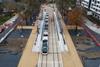







BELGIUM: The Liège tramway has opened to passengers, with the first commercial service leaving Liège-Expo at 04.22 on April 28.
The launch followed a formal inauguration ceremony on April 25. A public festival to celebrate the opening of the line is scheduled for May 10.
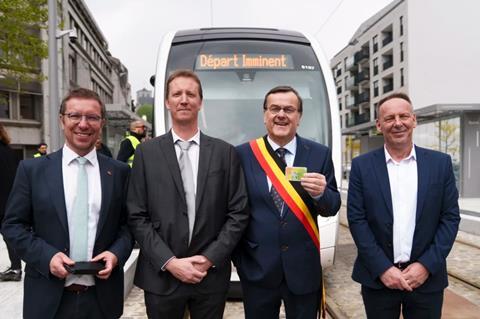
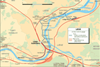
The 11·7 km line connects northern termini at Coronmeuse and Liège-Expo with a southern terminus at Sclessin-Standard, running parallel to the River Meuse via Place St Lambert and Guillemins railway station. There are 23 stops.
Trams operate from 05.00 to 01.00, running every 5 min in the peaks and every 7 to 15 min off peak.
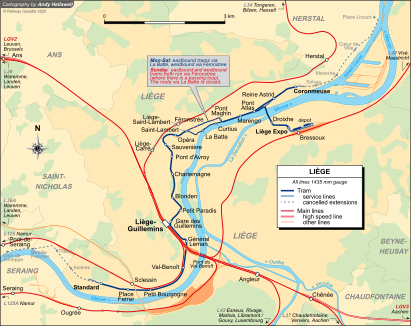
Services are operated by Opérateur de Transport de Wallonie, which uses the TEC brand. TEC said the opening of the tramway marks ‘the beginning of a new era for Liège mobility’. Local bus services have been revised to feed the tramway rather than run to the city centre, and are classified into five categories, with Busway services acting as a ‘quasi-tram’, Connect acting as an extension of tram services, and urban, inter-urban and express services.
Construction
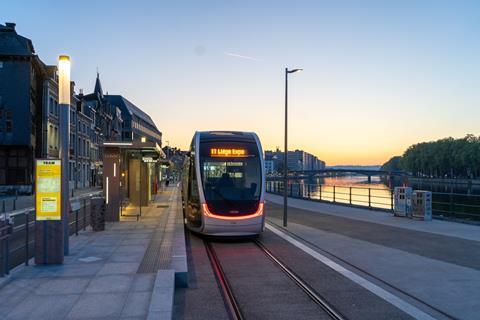
The tramway has been built by the Tram’Ardent consortium of Colas, CAF and the Dutch Infrastructure Fund under a design-build-maintain concession which is due to run until 2052.
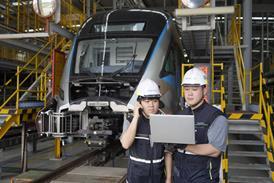
CAF has supplied 20 Urbos trams, 45 m long and 2 650 mm wide. These use battery power on three catenary-free sections of the route.
TEC puts the total cost of the project at €430m, covering both the infrastructure and the rolling stock. Of this total, €380m will be reimbursed to Tram’Ardent in the form of an investment fee paid quarterly until 2052. A maintenance fee, also paid quarterly, covers maintenance and renewal costs. There is also a payment for each kilometre operated. The payments total around €32m per year, and can be reduced if maintenance is insufficient or performance below standard.
The remaining €50m is for additional urban development works and is not part of the overall fee paid to Tram’Ardent.
The opening is around three years later than envisaged, the project having faced financial problems owing to the Covid pandemic and rising costs. The Wallonnie regional government agreed to contribute €79m to compensate for the extra costs and to increase the availability payments.
In 2024 plans to build extensions 2·9 km north and 3·2 km south were cancelled in favour of bus services.